What Is the Best Forklift Jib Attachment in 2026?
Choosing the best Forklift Jib Attachment in 2026 requires more than comparing prices and lifting capacity. The right model must match the forklift, load shape, working height, and site conditions. A compact jib may suit indoor maintenance work, while a telescopic design can provide greater reach outdoors. Small differences matter.
In real operations, I would inspect the attachment’s rated capacity, mounting method, boom adjustment, hook design, and visibility from the driver’s seat. A clearly marked capacity chart is essential. So is a secure locking system. A loose pin, worn hook, or poorly balanced load can create serious instability within seconds. The attachment should be compatible with the forklift manufacturer’s specifications and local workplace requirements. Independent inspection records also add valuable confidence.
However, the highest-rated jib is not automatically the best choice. Its capacity changes as the boom extends. Uneven loads can swing, rotate, or shift the forklift’s center of gravity. Operators need suitable training, pre-use checks, and controlled travel speeds. These practical details are often overlooked.
This guide compares popular forklift jib designs for performance, safety, durability, and value. It considers fixed, adjustable, and telescopic options. Realistic examples, such as positioning steel beams or lifting machinery components, will clarify each choice. Some recommendations may depend on assumptions. That is worth admitting. A reliable decision should be based on verified specifications, experienced evaluation, and the actual demands of your workplace.
Forklift Jib Attachments: Definition, Design, and Main Functions
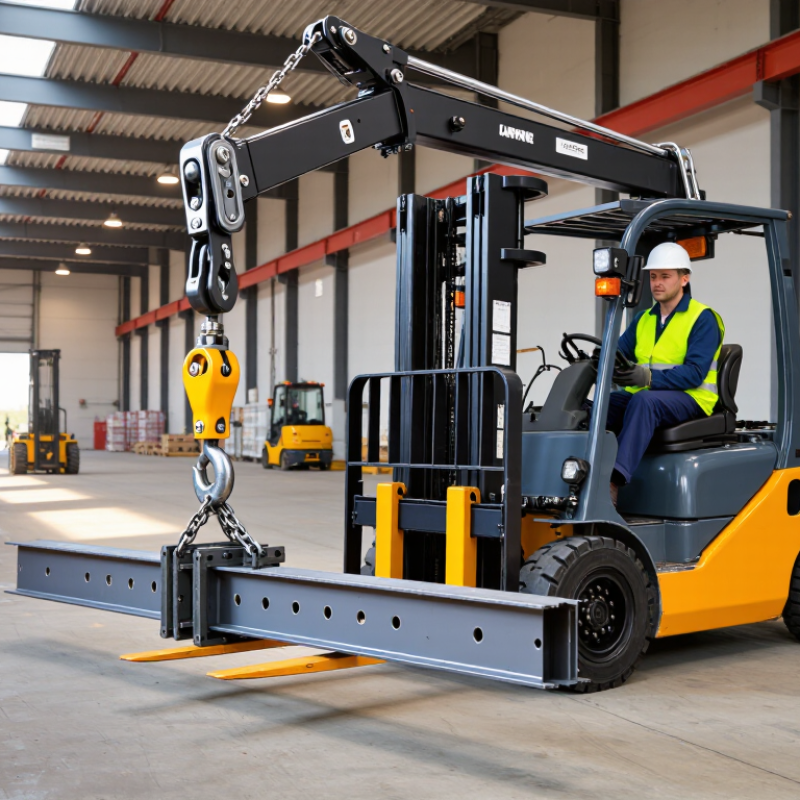
A forklift jib attachment is a removable boom that extends a truck’s lifting reach. It converts vertical fork movement into controlled horizontal positioning. Operators use it to handle pipes, coils, machinery, and loads with recessed lifting points. The best design in 2026 is not simply the longest one. It matches the truck’s rated capacity, carriage dimensions, and working height. That fit matters.
Most jibs use a reinforced steel boom, heel pockets, locking pins, and a rated hook or shackle point. Telescopic models provide adjustable reach, while fixed booms offer fewer moving parts. A useful attachment keeps the load close when extra reach is unnecessary. Extension increases leverage and reduces practical capacity. The load chart should show capacity at each position, not only the maximum rating. During inspections, I look for bent sections, worn pins, cracked welds, and unreadable labels. Small defects can become serious under shock loading.
Its main functions include lifting, placing, and positioning suspended loads. It can guide a motor into a frame or place a beam beyond the fork tips. The hook should swivel only when the design permits it. A latch helps retain the lifting connection, but it cannot correct poor rigging. Operators should center the load, move slowly, and keep people outside the fall zone. I have seen teams choose extra reach for convenience, then lose stability. That choice deserves review. A shorter jib with a clear load chart may perform better in a crowded aisle.
Key Factors for Choosing the Best Forklift Jib Attachment in 2026
What Is the Best Forklift Jib Attachment in 2026?
The best forklift jib attachment depends on the load, reach, and working environment. OSHA reports about 85 annual forklift-related fatalities and 34,900 serious injuries in the United States. These figures make capacity checks more than paperwork. Confirm the combined rating of the forklift, jib, hook, and lifting accessories. Measure the load center, not only the load weight. A 1,000-kilogram load can exceed limits when it hangs far from the carriage. Small details matter.
Choose a jib with visible capacity markings, secure carriage locking, and controlled telescopic adjustment. ASME B56.1 and ISO 3691-1 provide useful guidance for forklift stability, operation, and attachments. The attachment should not block the operator’s forward view. It should also suit narrow aisles, uneven floors, outdoor weather, and repeated lifting cycles. A smooth hook swivel helps, but it cannot correct poor load balance. It is easy to overlook that.
Before purchasing, review inspection records and test the attachment under controlled conditions. Check welds, pins, hooks, retaining devices, and hydraulic components. OSHA recommends operator training and pre-use inspections for powered industrial trucks. Maintenance teams should record defects with photographs and dates. I would not pretend that the most expensive jib is automatically safest. A neat specification sheet can still mislead. Experienced operators may reveal clearance problems that measurements miss. Short trials often expose them.
Comparing Fixed, Telescopic, and Adjustable Jib Attachment Types
What Is the Best Forklift Jib Attachment in 2026?
Fixed jib attachments suit repetitive lifting near the truck. Their short, rigid profile usually offers predictable handling and fewer adjustment points. This matters because OSHA estimates that forklifts cause about 85 workplace deaths and 34,900 serious injuries annually in the United States. Simplicity can reduce misuse, but it cannot replace training, inspections, or a verified load chart.
Telescopic jibs provide changing reach for beams, pipe, and equipment positioned behind racks. However, capacity typically decreases as the boom extends. A load that feels stable at 1.2 meters may become unsafe at 2.4 meters. Adjustable jibs add angle or length settings, helping crews handle varied tasks without changing attachments. They also introduce pins, locks, and adjustment errors. That trade-off deserves attention.
Experience on busy warehouse floors suggests choosing by the real lifting pattern, not maximum advertised reach. Check the combined forklift-and-jib rating, load center, boom position, and overhead clearance. ANSI/ITSDF B56.1 emphasizes using rated capacity and maintaining stability during operation. Operators should inspect welds, hooks, retaining devices, and locking pins before each shift.
The versatile option is not always best. A fixed jib may be safer for repeated, controlled lifts. A telescopic model may justify its complexity on irregular sites. Adjustable designs can save changeover time, although that benefit is easy to overestimate. One poor load-center assumption can erase the advantage. Record actual loads and reach distances for several weeks before purchasing.
What Is the Best Forklift Jib Attachment in 2026? - Comparing Fixed, Telescopic, and Adjustable Jib Attachment Types
| Comparison Dimension | Fixed Jib Attachment | Telescopic Jib Attachment | Adjustable Jib Attachment |
|---|---|---|---|
| Basic Design | A rigid boom with one permanent working length and a fixed hook or lifting eye. | A boom with one or more sliding sections that extend and retract along the main beam. | A boom with several preset positions, normally changed with locking pins or a manual adjustment system. |
| Typical Working Reach | Approximately 1.5–2.5 m from the fork carriage, depending on the attachment design. | Approximately 1.8–4.5 m, with the longest reach available only when the boom is fully extended. | Approximately 1.5–3.0 m across several manually selected positions. |
| Typical Attachment Weight | Approximately 100–250 kg. | Approximately 180–450 kg because of sliding sections, locking components, and reinforcement. | Approximately 130–320 kg, depending on the number of adjustment positions and boom length. |
| Typical Rated Attachment Capacity | Commonly about 1,500–3,000 kg at a specified load position. | Commonly about 1,000–2,500 kg; capacity generally decreases as the boom is extended. | Commonly about 1,250–2,500 kg, with lower capacity at longer preset positions. |
| Load-Position Flexibility | Limited. The hook position remains constant unless the forklift is repositioned. | High. The operator can change the reach to suit different load sizes and placement distances. | Medium to high. Several fixed reach positions provide flexibility without continuous telescoping. |
| Load-Center Effect | Usually the lowest load-center increase of the three types when used at a short, fixed reach. | Highest load-center impact when fully extended, which can substantially reduce the forklift's allowable capacity. | Moderate impact at short settings and higher impact at the longer preset positions. |
| Adjustment Speed | Fastest. No boom-length adjustment is required. | Fast during operation, but extension and retraction must be controlled carefully and may require hydraulic or manual operation. | Moderate. The attachment normally must be stopped and secured before changing the preset length. |
| Positioning Accuracy | Good for repetitive lifting tasks with a consistent pickup and placement distance. | Best for variable placement distances and work requiring precise reach control. | Good when the required reach matches one of the available locking positions. |
| Ease of Inspection | Generally easiest because it has fewer moving parts and no sliding boom sections. | Requires inspection of sliding surfaces, locking mechanisms, stops, welds, and any hydraulic components. | Requires inspection of adjustment holes, locking pins, retaining devices, welds, and wear points. |
| Maintenance Demand | Low, provided the hook, welds, fork pockets, and retaining devices are inspected regularly. | Medium to high because sliding sections, rollers, pins, or hydraulic parts need additional inspection and lubrication. | Medium because the adjustment hardware and locking points are exposed to repeated loading and wear. |
| Operational Visibility | Usually good because the boom profile is simple and compact. | Moderate. The extended boom may obstruct forward visibility and can increase the turning envelope. | Moderate to good, depending on the selected boom position and attachment frame design. |
| Best Application | Repetitive lifting, short-reach handling, maintenance work, and operations where simplicity is the priority. | Construction, equipment installation, plant maintenance, and tasks requiring different lifting distances. | General-purpose lifting where operators need several reach settings but do not require continuous adjustment. |
| Main Advantages | Simple construction, low maintenance, good durability, predictable handling, and generally lower purchase cost. | Longest reach range, excellent flexibility, and the ability to place loads at different distances without changing attachments. | Useful balance of flexibility, mechanical simplicity, and controlled preset reach positions. |
| Main Limitations | Limited reach flexibility and less suitable for loads that must be placed at varying distances. | Higher weight, higher cost, more maintenance points, and greater capacity loss at maximum extension. | Adjustment takes longer than telescoping, and the available reach is restricted to the preset positions. |
| Relative Cost Level | Low to medium. | High. | Medium. |
| Best Overall Choice | Best for stable, repetitive operations where the required reach rarely changes. | Best for maximum versatility and changing load-placement distances, subject to capacity verification. | Best for mixed-duty operations that need flexibility with simpler mechanics than a telescopic design. |
| Required Safety Verification | Confirm the forklift's rated capacity at the new load center, attachment weight, boom position, hook capacity, securing method, load stability, and applicable workplace lifting requirements before use. | ||
Data note: The figures shown are typical industry ranges for general-purpose forklift jib attachments, not universal ratings. Actual capacity, reach, attachment weight, and load-center limits vary by forklift capacity, fork-carriage geometry, attachment design, boom angle, and load configuration. The manufacturer's attachment rating and the forklift capacity chart must always take precedence.
Safety Standards, Load Capacity, and Compatibility Requirements
What Is the Best Forklift Jib Attachment in 2026?
Safety Standards, Load Capacity, and Compatibility Requirements
In 2026, the best forklift jib attachment is not simply the longest or strongest model. It must match the forklift, the load, and the working environment. During site checks, I look for a readable capacity plate, secure retaining pins, and clean welds. A compliant attachment should include engineering data, inspection guidance, and clear working load limits. Requirements vary by region, so confirm current standards with a qualified safety professional.
Load capacity needs careful calculation. The attachment’s rating is not the forklift’s original capacity. A jib moves the load center forward, which can reduce safe lifting capacity sharply. Check the forklift data plate, attachment rating, boom angle, and actual load weight. Include slings, hooks, and the attachment itself. A 1,000-kilogram load may exceed the safe limit when positioned far from the carriage. Never rely on a quick visual estimate. That shortcut is tempting.
Compatibility starts with the carriage class and mounting method. Confirm fork-pocket dimensions, locking arrangements, pin size, and any required hydraulic connection. The jib should sit evenly, resist sideways movement, and remain secure during braking. Use approved lifting accessories with legible limits. Inspect for cracks, bent sections, worn hooks, and damaged safety latches before each shift. Operator training matters, especially during slow travel and suspended-load control. I would test the setup with a small, authorized load first. It is not a perfect guarantee. Real conditions can expose assumptions.
Maintenance Practices and Emerging Trends in Forklift Jib Attachments
What Is the Best Forklift Jib Attachment in 2026?
Maintenance now matters as much as attachment design. A suitable forklift jib should match the load chart, hook position, boom length, and site conditions. OSHA reports about 85 forklift-related fatalities and 34,900 serious injuries annually in the United States. That figure makes routine inspection more than paperwork.
Technicians should check boom welds, retaining pins, cotters, hooks, latches, and hydraulic connections before every shift. Look closely for stretched holes, cracked paint, bent steel, and oil under fittings. The capacity plate must remain readable. It should also reflect the actual configuration. ANSI/ITSDF B56.1 guidance supports documented inspections, trained operators, and controlled attachment use. Small defects become expensive failures.
Emerging attachments increasingly use load sensors, telematics, and digital inspection records. These systems can flag overloads, shock loading, and unusual operating hours. The 2024 MHI Annual Industry Report found that 40% of supply-chain professionals ranked robotics and automation among their investment priorities. That trend will influence jib maintenance, especially in busy warehouses. Electric forklifts may reduce exhaust exposure, but they do not remove structural wear. A clean dashboard is not proof of safety. Field teams still need hands-on checks. The best attachment is often the one workers can inspect quickly and maintain correctly, although that practical answer is less exciting than a fully connected system.
What Is the Best Forklift Jib Attachment in 2026?
Maintenance readiness is a key factor when selecting a forklift jib attachment. This planning benchmark shows the annual frequency of common maintenance checkpoints for a jib attachment used on approximately 250 operating shifts per year. Daily inspections should be completed before use, while lubrication and detailed examinations must follow the attachment manufacturer’s instructions, site procedures, and applicable safety regulations.
Planning basis: 250 operating shifts per year. Inspection frequency can vary according to operating environment, load conditions, attachment design, and local requirements.
Related Posts
-
Top Benefits of Using Forklift Jib for Material Handling?
-
What Are the Top Forklift Jib Boom Types for Buyers?
-
China Top Forklift Boom Extension Suppliers?
-
Innovative Solutions for Efficiently Utilizing Adjustable Gantry Cranes in Industrial Settings
-
The Future of Mobile Gantry Cranes in Modern Industries
-
What Is a Gantry Crane and How Does It Work?