
2026 Top Injection Molding Automation Systems for Buyers
Injection Molding Automation can help manufacturers move parts, reduce repetitive handling, and keep production flowing. But the right system depends on the press, product, and factory layout—not a ranking alone. A compact three-axis takeout robot may suit a straightforward packaging job, while a six-axis robot may handle more complex part placement. Details matter.
This 2026 buyer’s guide examines automation systems and the practical questions behind choosing them. It considers robot reach and payload, end-of-arm tooling, part conveyors, vision inspection, material handling, and connections to existing equipment. Buyers should also check cycle-time targets, mold-change frequency, floor space, operator access, and the supplier’s service coverage. A robot that fits the brochure can still struggle beside a crowded press.
Look closely at changeover steps. Ask who programs new part recipes, how faults appear on the control screen, and whether spare grippers are readily available. Request references from installations with similar parts and production volumes. Then verify performance against your own requirements. One limitation is easy to overlook: advertised cycle times may not include downstream handling or inspection. Real production is messier. A timed trial can reveal that gap.
The systems covered here offer different levels of flexibility, integration, and support. Use the comparisons to build a shortlist, then confirm fit with your plant team and the equipment supplier. Good automation should solve a defined production problem—not add complexity for its own sake.
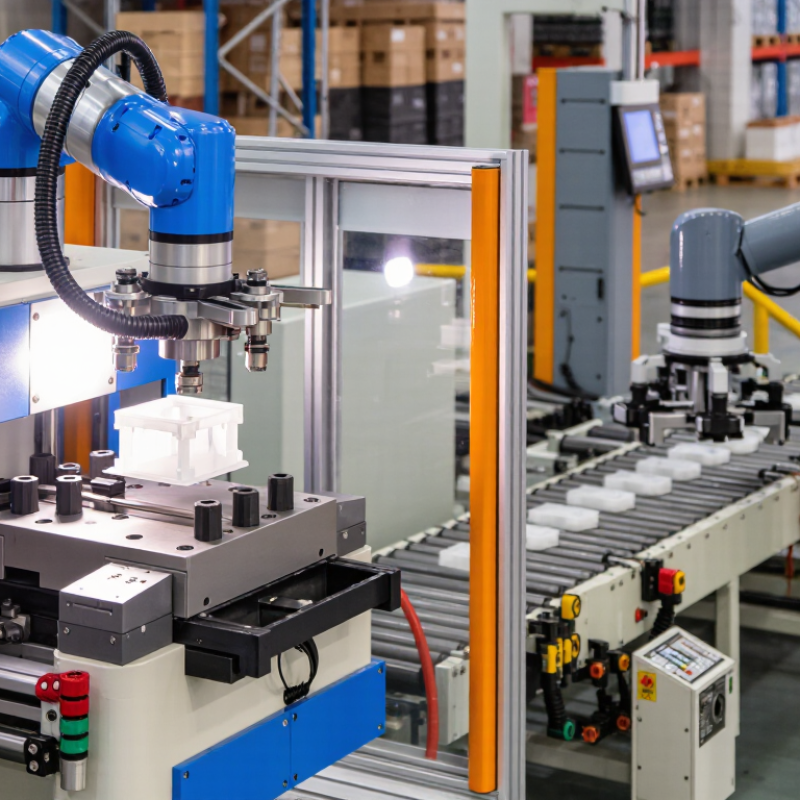
Understanding Injection Molding Automation Systems and Their Core Functions
2026 Top Injection Molding Automation Systems for Buyers
Understanding Injection Molding Automation Systems and Their Core Functions
An injection molding automation system connects equipment that moves parts through production. A typical cell may include a takeout robot, a conveyor, a sprue separator, and inspection tools. Each component has a specific job. Together, they reduce manual handling and help keep cycle times consistent.
The robot removes each molded part after the mold opens, then places it in a defined position. Conveyors carry parts to trimming or packing stations, while vision systems can check for visible defects, such as flash or incomplete features. Material dryers and feeding units help maintain steady resin supply. Sensors and safety interlocks support controlled operation, but setup and regular checks still matter. Small alignment errors can cause repeated stoppages.
Fit matters more than feature count. Buyers should consider machine size, mold layout, part weight, cycle time, and the space available around the press. Ask how quickly operators can change grippers or adjust recipes. No cell is perfectly hands-off. Some parts still need careful inspection, and automation can make a poor process repeat faster. That is easy to overlook. A practical system should improve handling, protect product quality, and give operators clear access to useful production data.
2026 Top Injection Molding Automation Systems for Buyers — Understanding Core Functions
Typical sequence in a robot-assisted injection molding cell
The bars show sequence order, not duration or performance. A typical cell coordinates mold opening, robot entry, part removal, optional insert placement, robot exit and mold closing. Exact sequences depend on the part, mold and production setup.
Types of Automation Used in Modern Injection Molding
Modern injection molding uses several automation types, often combined around one press. A takeout robot removes parts from the mold and places them on a conveyor, cooling fixture, or inspection station. A sprue picker handles runners separately when the mold produces them. Small details matter: part orientation, drop height, and the time a component spends cooling can affect downstream handling.
More advanced cells use vision systems to check features such as color, presence, or visible flash. A robot can sort rejected parts before they mix with acceptable production. In-mold labeling and insert loading automate work inside the molding cycle, but they require careful coordination with mold design and cycle timing. Trimming, assembly, and packaging equipment can also be integrated after molding. These steps may reduce repetitive handling, though each added station needs space and maintenance access.
Automation should match the part and production goal, not just the press size. A heavy robot may be unnecessary for a simple, stable part. Yet a compact cell can become difficult to service if fixtures block access or sensors are poorly placed. Test the full sequence with real parts, including startup and changeover. That is where assumptions often show. A little manual flexibility can still be useful.
2026 Top Injection Molding Automation Systems for Buyers - Types of Automation Used in Modern Injection Molding
| Automation System | Typical Configuration | Primary Function | Common Applications | Buyer Considerations |
|---|---|---|---|---|
| Sprue Picker | Compact, usually single-axis or simple multi-axis unit mounted near the molding machine | Removes sprues or runners from the mold area after the machine opens | Simple molding cells, short-cycle production, and applications where runner removal is the main handling task | Check reach, payload, removal timing, guarding, and whether the runner can be handled without disturbing the molded part. |
| Cartesian Take-Out Robot | Overhead linear robot with typically three perpendicular axes | Extracts molded parts and places them onto a conveyor, chute, fixture, or downstream station | High-volume production, repeatable part handling, and cells requiring consistent pick-and-place movements | Match the robot’s working envelope and payload to the mold layout, part dimensions, end-of-arm tooling, and required cycle sequence. |
| Six-Axis Industrial Robot | Articulated robot with six rotary axes, installed inside or beside the molding cell | Performs flexible part extraction, orientation, loading, trimming, or transfer between processes | Complex part orientations, multi-operation cells, and production involving different part-handling paths | Review reach, payload, wrist clearance, programming needs, cell footprint, safety measures, and integration with the machine controller. |
| Part Conveyors and Handling Systems | Belt, roller, or other application-specific conveying equipment connected to the molding cell | Moves finished parts, runners, or containers away from the machine and toward inspection or packing | Production lines that need organized part discharge, collection, or transfer to downstream operations | Consider part orientation, conveyor speed, accumulation needs, available floor space, and how rejected parts will be separated. |
| Vision-Guided Inspection | Camera-based inspection station, often paired with lighting, image-processing software, and part handling | Checks visible features such as presence, orientation, color, surface defects, or selected dimensions | In-line quality checks and sorting where the relevant defect or feature can be reliably observed by a camera | Confirm inspection criteria, lighting conditions, camera position, acceptable false-reject rates, and the method for handling failed parts. |
| Insert Loading and Overmolding Automation | Robot or dedicated loading mechanism with fixtures for positioning inserts in the mold | Places metal, plastic, or other approved inserts into the mold before the molding cycle | Insert molding and overmolding processes that require consistent insert placement and retention | Evaluate insert presentation, orientation control, placement accuracy, presence verification, and safeguards against molding with a missing insert. |
| In-Mold Labeling and Decoration Handling | Robot or handling equipment that places labels, films, or decorative components into the mold | Positions the selected material before injection so it becomes integrated with or applied to the molded part | Parts designed for in-mold labeling, film decoration, or related mold-based surface treatments | Check material compatibility, label or film presentation, positioning repeatability, static control where relevant, and mold-cycle coordination. |
| Resin Drying and Material Conveying | Dryers, hoppers, loaders, vacuum conveying lines, and material-control equipment | Delivers resin to the molding machine and, when required, dries moisture-sensitive materials before processing | Centralized or machine-side material supply, especially where several machines or resin types are used | Use resin-specific drying requirements; assess conveying distance, material segregation, filtration, moisture control, and changeover procedures. |
| Automated Part Sorting and Packaging | Combination of conveyors, sensors or vision systems, sorting gates, and packing equipment | Counts, separates, or packages parts after molding and inspection | Production requiring organized output, part counting, reject separation, or repeatable packaging workflows | Define pack quantity, container or packaging format, traceability needs, reject handling, and the interface with upstream inspection. |
| Automated Mold Change and Setup Support | Combination of mold-handling equipment, quick-connect services, setup procedures, and machine controls | Supports mold exchange and helps standardize selected changeover tasks | Facilities that frequently change molds or need structured, repeatable setup workflows | Plan for mold weight and dimensions, lifting and clamping procedures, utility connections, safety interlocks, and operator training. |
How to Compare Leading Injection Molding Automation Systems in 2026
2026 Top Injection Molding Automation Systems for Buyers
Compare systems by their performance at the press, not by robot payload alone. Check whether the robot can reach the mold, remove parts without scuffing them, and place them consistently on a conveyor or fixture. Ask suppliers to demonstrate the proposed cycle using your actual part, gripper, and machine interface. Small details matter: cable routing, mold-clearance limits, and the time needed for a tool change can disrupt a cell that looked efficient on paper.
Industry data offers useful context, but not a direct ranking. The International Federation of Robotics’ World Robotics 2024 report recorded 541,302 industrial robot installations worldwide in 2023. Deloitte’s 2024 Smart Manufacturing Survey found that 86% of surveyed manufacturing executives expect smart manufacturing to drive competitiveness within five years. Neither figure proves a specific molding cell will pay back. Compare measured cycle time, uptime, reject rate, changeover time, and operator intervention instead.
Ask for comparable production trials and a clear breakdown of integration, training, maintenance, and spare-part costs. Confirm how alarms, recipe changes, and quality records connect to existing systems. The awkward part: a faster cycle can create downstream bottlenecks. A spreadsheet may miss that. Include a real shift’s worth of parts and a planned changeover in the evaluation, then question any result that depends on ideal conditions.
Key Buyer Criteria: Compatibility, Safety, Support, and Total Cost
2026 Top Injection Molding Automation Systems for Buyers
A capable automation system should fit the press, mold, and existing controls—not force an expensive redesign. Check robot reach, payload, controller signals, guarding space, and part take-out timing on the actual production cell. Run a dry cycle with the intended mold and end-of-arm tooling. Small mismatches matter. The International Federation of Robotics reported 4.28 million industrial robots operating worldwide in 2023, up 10% from 2022. This is a broad factory benchmark, not a molding-specific forecast. Buyers should still verify performance against their own parts and cycle times.
Safety and support deserve equal attention to speed. Request a documented risk assessment, suitable guarding, interlocks, emergency-stop integration, and practical operator training. Confirm who handles commissioning, spare parts, and urgent troubleshooting—and how quickly help is available. Then compare total cost, including installation, tooling changes, maintenance, energy, training, and downtime, not just the purchase price. A spreadsheet can miss the awkward bits. Quoted cycle-time savings may shrink during mold trials, color changes, or frequent product swaps. Ask suppliers to show the assumptions behind their figures and test them against a representative production run.
Planning Integration, Workforce Training, and Long-Term Performance
2026 Top Injection Molding Automation Systems for Buyers
Planning an automation cell starts with the part, mold, and cycle—not the robot alone. Map the full sequence: mold opening, part removal, inspection, trimming, and packing. Check reach, payload, guarding, and signal handshakes before equipment arrives.
A few seconds of mismatch can leave a robot waiting at an open mold. It adds up.
Integration also depends on people. The International Federation of Robotics reported 541,302 industrial robots installed worldwide in 2023, reflecting broad adoption—but installation does not guarantee smooth operation. Operators need hands-on practice with safe stops, recovery steps, and routine changeovers.
The Manufacturing Institute and Deloitte estimated that 3.8 million manufacturing jobs may be needed in the United States by 2033, with 1.9 million potentially unfilled. Training time deserves a place in the project plan. Not an afterthought.
Long-term performance needs a baseline. Record cycle time, scrap rate, unplanned stops, and changeover duration before commissioning, then review them monthly. Keep spare grippers, sensors, and cables accessible, and train more than one person to troubleshoot common faults.
A tidy cell drawing can still miss awkward cleaning access. Review it with the people who will maintain the equipment, and revise the plan when real production proves it wrong.
