
China Top 10 Adhesive Sealant Manufacturers
China’s adhesive and sealant sector serves construction, automotive, electronics, packaging, and infrastructure projects. Choosing a manufacturer is not just about comparing product catalogs. Buyers need to assess technical support, production consistency, certification, and performance under real operating conditions.
Grand View Research estimated the global adhesives and sealants market at USD 73.2 billion in 2023, with projected growth of 5.4% annually from 2024 to 2030. This broader market figure includes many adhesive and sealant categories; it should not be mistaken for a China-only estimate. Still, it signals the scale of demand and the pressure on suppliers to deliver dependable products. Small details matter. A sealant that cures well in a laboratory may behave differently on a dusty jobsite or in a humid production room.
Adhesion-science specialist Dr. Steven Abbott’s technical guidance emphasizes the importance of surface preparation to reliable bonding. That practical point helps explain why supplier evaluation should extend beyond price and headline specifications. This Top 10 overview examines Chinese manufacturers through their product ranges, application experience, quality systems, and ability to support customers. A neat ranking can still miss important differences. Company information and performance claims should be checked against current technical documentation and project needs before a purchasing decision.
Adhesive Sealants in China: Industry Scope and Product Categories
China’s adhesive sealant sector serves construction, packaging, transport, electronics, and consumer goods. Adhesives join surfaces; sealants fill gaps and limit water, air, dust, or vibration. Some products do both, so the boundary is not always tidy. That distinction matters.
Product categories are commonly grouped by chemistry and curing method. Water-based and hot-melt adhesives are used in packaging and woodworking, while reactive epoxy and polyurethane systems support structural bonding. Silicone, acrylic, and polyurethane sealants appear around window frames, façades, and vehicle joints. On a job site, the choice may depend on substrate, movement, moisture, and application temperature—not just the product label.
Not one market. MarketsandMarkets estimated the global adhesives and sealants market at USD 78.6 billion in 2023, with a forecast of USD 92.6 billion by 2028. These figures describe the world market, not China alone. For Chinese manufacturers, demand spans high-volume packaging grades and more specialized products for electronics and transport. Product classifications can also vary between reports, which makes direct comparisons less clean than they look. A useful assessment should check whether a source counts tapes, construction sealants, or only formulated adhesives.
How China’s Adhesive Sealant Manufacturers Are Evaluated
Evaluating China’s adhesive sealant manufacturers takes more than comparing annual output or catalogue size. Buyers should review technical data sheets, batch traceability, and test results for adhesion, movement, curing time, and weather resistance. A lab report should identify the test method, specimen conditions, and date—not just display a pass mark. For construction sealants, ASTM C920 provides a recognized framework for classifying elastomeric joint sealants. ISO 9001 certification can support quality-system checks, but it does not prove that every product performs equally well.
Market figures help explain why careful screening matters. Grand View Research’s Adhesives and Sealants Market Size, Share & Trends Analysis Report estimated the global market at USD 78.5 billion in 2023, with projected annual growth of 4.7% from 2024 to 2030. That broad estimate is context, not evidence of any individual factory’s capability. A practical supplier review should compare independent test records, production consistency, technical support, and sample performance under the buyer’s actual temperature and substrate conditions. Check the details. A sealant may look smooth in a cartridge yet cure unevenly across a wide joint. No scorecard is perfect; even well-documented suppliers can leave questions about long-term field performance.
China Top 10 Adhesive Sealant Manufacturers - How China’s Adhesive Sealant Manufacturers Are Evaluated
Evaluation framework, not a verified ranking of named manufacturers. The weights below are suggested editorial criteria; company-specific performance must be confirmed using current documents, test reports, and audits.
| No. | Evaluation dimension | Suggested weight | Evidence to review | What strong evidence indicates |
|---|---|---|---|---|
| 1 | Product range and chemistry | 12% | Current product catalogues and technical data sheets for silicone, polyurethane, acrylic, and other relevant sealant types. | Clearly specified products matched to distinct applications, substrates, and service conditions. |
| 2 | Standards and regulatory compliance | 14% | Valid certificates, declarations, and product test reports relevant to the intended market and application. | Claims are supported by applicable, current documentation; certificate scope and product identity can be checked. |
| 3 | Quality management and process control | 14% | Quality-system documentation, inspection records, batch controls, nonconformance procedures, and relevant audit results. | Documented controls support consistent production and enable investigation of quality issues. |
| 4 | Product testing and performance data | 12% | Test reports for properties relevant to use, such as adhesion, movement capability, curing, weathering, or durability. | Results identify the tested product, method, conditions, and laboratory; independent reports are especially useful. |
| 5 | Research, development, and technical support | 12% | Technical staffing, product-development records, application guidance, and documented troubleshooting support. | The supplier can explain product selection, surface preparation, compatibility, and limitations for the stated use. |
| 6 | Manufacturing capability and capacity | 10% | Facility audit, production-line information, capacity statements, and evidence of equipment maintenance and process monitoring. | Capacity claims are verifiable and production controls are appropriate for the requested product and order volume. |
| 7 | Customization and packaging options | 8% | Written specifications for color, viscosity, packaging format, private-label services, and minimum order quantities. | Requested changes are defined in writing, with sample approval and change-control steps documented. |
| 8 | Delivery reliability and traceability | 7% | Order and shipment records, stated lead times, shelf-life information, batch coding, and complaint-response procedures. | Products can be traced by batch, and delivery and after-sales processes are clearly documented. |
| 9 | Environmental, health, and safety management | 6% | Safety data sheets, chemical-handling information, relevant environmental documentation, and facility EHS records. | Hazards, storage, handling, and disposal information is available and appropriate for the product and destination market. |
| 10 | Commercial transparency and customer service | 5% | Written quotations, product specifications, warranty terms, payment conditions, and response records. | Commercial terms and product claims are consistent, clear, and available for review before purchase. |
| Total suggested weight | 100% | Use the same evidence requirements and scoring scale for every supplier being compared. | ||
Profiles of China’s Top 10 Adhesive Sealant Manufacturers
Profiles of China’s top adhesive sealant manufacturers are most useful when they show what each producer actually makes. MarketsandMarkets estimated the global adhesives and sealants market at USD 80.1 billion in 2023, forecasting USD 102.6 billion by 2028. This growth reflects demand across construction, packaging, transport, and electronics.
A useful distinction: product focus matters more than a broad catalogue. A practical shortlist can compare ten profiles: silicone weatherproofing, polyurethane construction, automotive bonding, flexible-packaging adhesives, electronic assembly, woodworking, flooring, waterproofing, industrial maintenance, and contract manufacturing.
For each profile, examine production scale, technical support, stated test methods, and consistency between batches. Ask for viscosity and cure-time data, plus substrate-specific guidance; a neat sample bead proves little about field performance. Check whether technical documents explain storage, surface preparation, and temperature limits.
That caveat matters: public profiles can be polished, while application results depend on the joint design, site conditions, and installer practice.
Key Products, Technologies, and Industries Served
China’s adhesive sealant manufacturers produce silicone, polyurethane, acrylic, epoxy, and silane-modified products for different bonding and sealing demands. Silicone sealants handle movement around windows and curtain walls, while polyurethane products often suit flooring, vehicle assembly, and construction joints. Acrylic formulations are useful for interior gaps that need paintability. Product names alone reveal little.
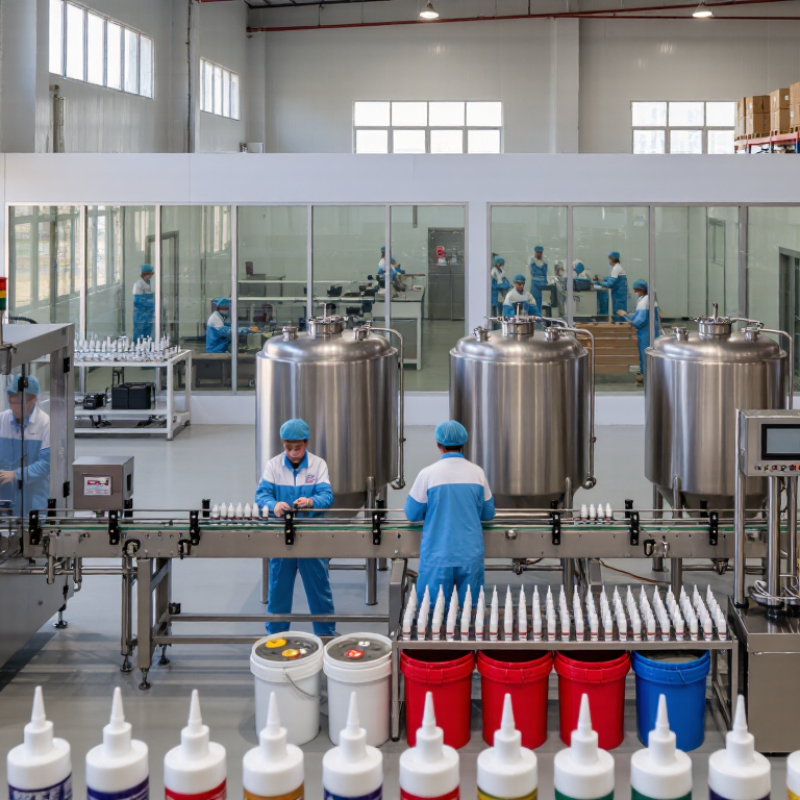
Manufacturing expertise also appears in cure chemistry, viscosity control, and packaging. One-component sealants may cure through moisture in the air; two-component systems require careful mixing before application. On a job site, installers notice practical details: how smoothly a cartridge dispenses, whether a bead holds its shape, and how long the material remains workable. Small differences matter.
Applications span construction, automotive production, electronics, renewable energy equipment, and home improvement. Buyers should compare substrate compatibility, movement capability, cure time, and test data under relevant conditions. A laboratory result is helpful, but it may not predict performance on a dusty surface or in cold weather. A catalog can make selection look simple. It isn’t always. Asking for technical documentation and sample testing can expose gaps before full-scale use. Sealants still depend on surface preparation, joint design, and installation quality. These details are easy to underestimate.
Comparing Manufacturers by Quality, Capacity, and Market Focus
Comparing China’s adhesive sealant manufacturers calls for more than a catalog review. Quality shows up in repeatable details: viscosity across batches, curing time, adhesion to glass or aluminum, and clear technical data. Ask for recent test reports and samples from regular production, not only specially prepared samples. A neat laboratory result helps, but it does not prove every shipment will behave the same way. Details matter.
Capacity is not just a large factory floor. Check monthly output for the specific product, available production lines, packaging options, and typical lead times during peak demand. A supplier may offer impressive volume yet struggle with small, customized orders. Another may be flexible but unable to support a sudden increase. Not always obvious. A factory visit or a documented production review can clarify the difference, though neither guarantees future performance.
Market focus also shapes the comparison. Manufacturers serving construction projects may prioritize weather resistance and compatibility with common building materials, while industrial suppliers may emphasize process consistency or specialized curing needs. Match these strengths to the application. Request written specifications, storage guidance, and sample evaluation on the actual substrate. I would be cautious about ranking suppliers from public claims alone; capacity figures and quality language can be hard to compare fairly. A few practical checks often reveal more than a polished brochure.
China Top 10 Adhesive Sealant Manufacturers — Comparing Manufacturers by Quality, Capacity, and Market Focus
This chart presents an equal-weight framework for comparing manufacturers, not company-specific scores. Assess each manufacturer on product quality, production capacity, market focus, and compliance; verify company-level information independently.
